Athletes Intell: Scaling Mental Performance Training for Student-Athletes

Student-athletes spend thousands of hours training their bodies. Athletes Intell is building the platform to train their minds.
Mental performance is the final frontier of athletic training, and one of the most neglected. At the high school and college levels, only a fraction of student-athletes ever receive formal mindset coaching, leaving them unprepared when adversity hits. Athletes Intell, founded by Matt Chiusano, is building a digital mental performance platform to help athletic departments scale that training for every athlete on their roster. We spoke with Matt (M.C.).
What gave you the idea for Athletes Intell?
M.C.: The idea for Athletes Intell started after I had the opportunity to speak with several professional athletes, former Olympians, and even an Olympic gold medalist. What stood out to me was that, regardless of the sport or level, one theme kept coming up: mindset. One professional athlete told me, “Mindset is everything,” and that really stuck with me. The athletes who separate themselves are often the ones who know how to handle pressure, respond to failure, and keep believing when things get hard. That realization is what inspired me to create Athletes Intell.
What is most meaningful to you about creating this product?
M.C.: As a former student-athlete at Johns Hopkins, I look back and realize there were so many areas where mindset training could have helped me perform better. I know so many athletes are working hard and striving to achieve excellence, but many are missing a key piece of their development because they are not being taught how to train their mindset. That is what makes this so meaningful to me. I created Athletes Intell so athletic departments can give student-athletes the mindset training they need to reach their full potential.
Are there sports stories where the impact of mindset really showed a difference in performance?
M.C.: There are so many powerful sports stories I could discuss in which athletes overcome failure, injuries, setbacks, and pressure to reach the next level. But what is even more compelling is that research is beginning to prove what those stories already show: Success is not just about talent. Studies show one of the strongest predictors of success is grit, which is the ability to stay resilient and committed when things get difficult. That is why mindset matters so much. The athletes who separate themselves are often not just the most talented—they are the ones who know how to respond when things get hard.
Tell me more about the solution.
M.C.: At the high school and college levels, only a small percentage of student-athletes consistently have access to mental performance training. I wanted to create a way for athletic departments to help student-athletes build those mental skills into their daily routines. In-person sessions are incredibly valuable, but with everything student-athletes balance between school, practice, games, and life outside of sports, consistent support can be hard to access. Athletes Intell is designed to make mental performance training more accessible and efficient so student-athletes can work on their mindset daily.
What needs to change from a stigma standpoint?
M.C.: Through various surveys I’ve conducted, I’ve found that many athletes still feel that wanting to improve mentally means something is wrong or that the player is soft. But when you look at the best athletes in the world, they train their mindset at the highest level. For example, LeBron James, one of the best basketball players ever, has been seen meditating during playoff games. Simone Biles, Novak Djokovic, Tom Brady, and many other top athletes also focus heavily on their mindset. Mental performance training does not mean something is wrong with an athlete. It means the athlete is focused on reaching peak performance.
What is the differentiator of your solution?
M.C.: A key differentiator is our mindset library, which gives athletes examples, tools, and exercises based on what they are personally struggling with. We have also grown a 20,000-plus social media following in a matter of months, allowing us to test which mindset tips and exercises resonate and use those insights to continuously refine our platform. Mental performance is not one-size-fits-all. Every athlete has a different journey, so we want to give them the ability to choose the areas where they need support and practice exercises that directly help them improve.
How does your solution help athletes think about performance, not mental health?
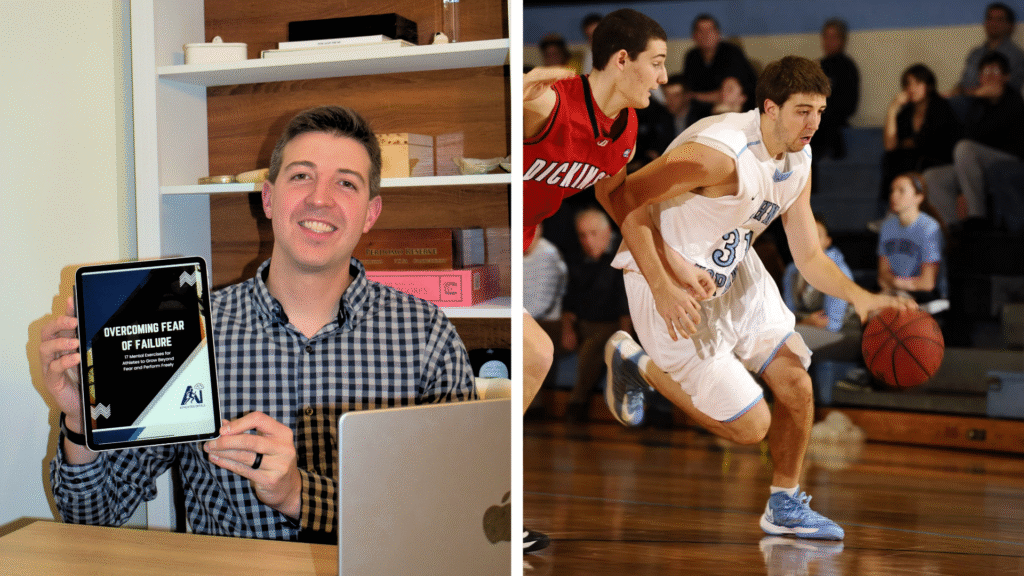
M.C.: Athletes Intell helps athletes think about performance by connecting mental skills directly to what they experience in practice, games, and competition. For each mental exercise, we explain why it works based on research and give an example of how the exercise can be applied. We also recently created and released Overcoming Fear of Failure, a mental performance journal with exercises athletes can use to build confidence, manage pressure and anxious thoughts, reset after mistakes, improve focus, and develop resilience. We have generated early revenue with this journal release, which shows there is real interest in practical mindset tools for athletes. These skills support overall well-being while also helping athletes understand how training their mindset can lead to better performance in their sport.
What has it meant for you to be back at Johns Hopkins University?
M.C.: Being back at Hopkins has been an amazing experience. It has given me the chance to reconnect with the Hopkins community and meet incredible alumni who are doing great things in their respective fields. I have learned so much through this accelerator, not only from the mentors and advisers, but also from being part of a cohort of founders building innovative companies. I feel very lucky to be part of it. It has helped me grow my venture, but it has also helped me grow as a person.